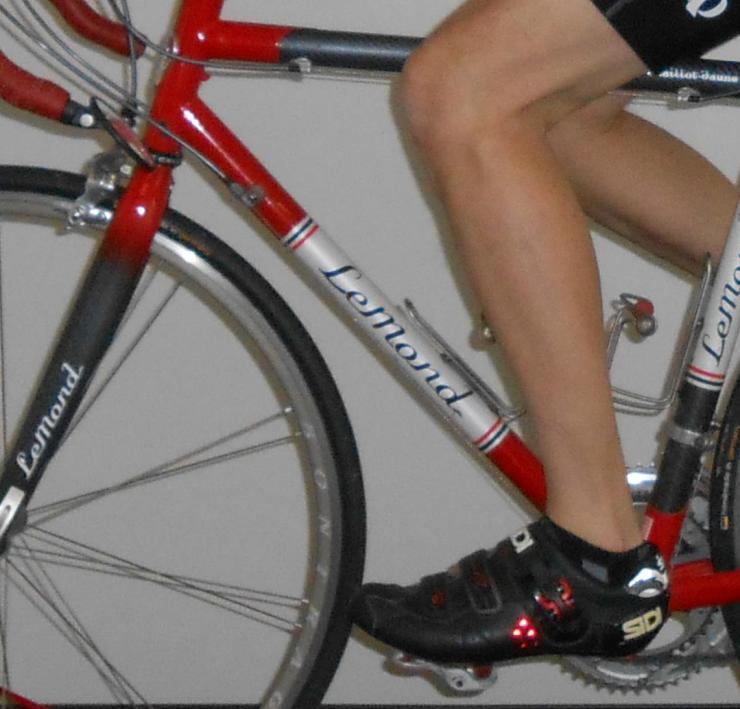
In cycling there are many ways to spend your money to improve performance. But what really matters?
Here is a researched based look at this topic. Authors Jeukendrup and Martin wrote a review article originally published in the journal of Sports Medicine as a way to guide how we should spend our time and money in improving cycling performance. The authors used a mathematical model to predict times savings over a 40 Km Time Trial. The factors they examined are seen in the tables below.
| Internal factors | Time Savings over a 40K Time Trial |
| Training | 1-7 minutes, 20-38% increase in VO2 max |
| Altitude training | 23-34 seconds |
| Nutrition-carbohydrate electrolyte solutions | 32-42 seconds |
| Nutrition- Caffeine | 55-84 seconds |
| External factors: Body and bicycle mass | Time Savings over a 20K 6% uphill grade | ||
| Bicycle mass: 7kg frame vs a 10kg frame | Novice | Trained | Elite |
| 3:38 | 1:52 | 1:15 | |
| External factors: Body and bicycle mass | Time Savings over a 40K Time Trial | ||
| Body mass: a decrease in 3Kg | Novice | Trained | Elite |
| 25 seconds | 21 seconds | 19 seconds | |
| External factors: Aerodynamics | Time Savings over a 40K Time Trial | |||
| Body position | Position | Novice | Trained | Elite |
| Brake hoods | Starting point | |||
| Drops | 3:46 | 3:06 | 2:47 | |
| Standard Aero | 6:49 | 5:36 | 4:59 | |
| Optimized Aero | 9:21 | 7:42 | 6:54 | |
| Bicycle frame – Aerodynamic | 1:17 to 1:44 Min:Sec | |||
| Aero Wheels | 60-82 seconds | |||
| Wheel Choice: weight vs Aerodynamics | See comments below | |||
Discussion: For the most part the data speaks for itself, but a few points can be made.
Degree of improvement: A trend in the data appears which is the better trained cyclist or even the elite cyclist saves less time from the changes made as compared the novice cyclist. In other words the novice has much more room for improvement and therefore he or she will make larger relative improvements. The trained and elite cyclist of course still have the overall faster times, but relatively make less change.
Aero wheels verse a lighter non-aero wheels: Areo wheels provide less drag and are a faster choice for all riders on flat to 3% graded surfaces, but these also tend to be a heavier wheel. At a 6% grade the novice and trained riders were faster with the non-aero wheels. At a 12% grade the novice, trained and elite riders were faster with the lighter weight, non-aero wheels.
Training: Based on the above table, 1-7 minutes of improvement. Need more be said?
You may have the perfect bike fit, but what about your body on your bike? Offering Physiofit Bike Sessions with video analysis. Email Adam for details at . . .
Bodymechanics physical therapy. Madison’s only Bike PTTM Certified therapist.
Madison’s only Certified Functional Manual TherapistTM
Source:
Jeukendrup AE, Martin J. Improving cycling performance: how should we spend our time and money. Sports Medicine. 2001;31(7);559-69.